


The Margin Pressure You Are Managing Every Day
If you look at your portfolio in any given month, you probably see the same pattern. Labor is your largest line item, regulators keep adding expectations, and families expect higher levels of service and communication (1). You often carry the responsibility of a large health system, but you do it with a lean central team and limited technology support.
Labor usually represents about 50 to 60 percent of your operating expenses in assisted living and memory care (2). At the same time, state survey findings, complaints, and clinical incidents can quickly shift from quality issues to financial issues. Fines, temporary admission freezes, and reputational damage all show up in your margins (3).
In this environment, an EHR is not simply “where notes go.” When you and your teams use it consistently, it becomes one of the few tools that touches labor, revenue, risk, and scalability at the same time.
How Senior Living EHR Systems Support Better Margins
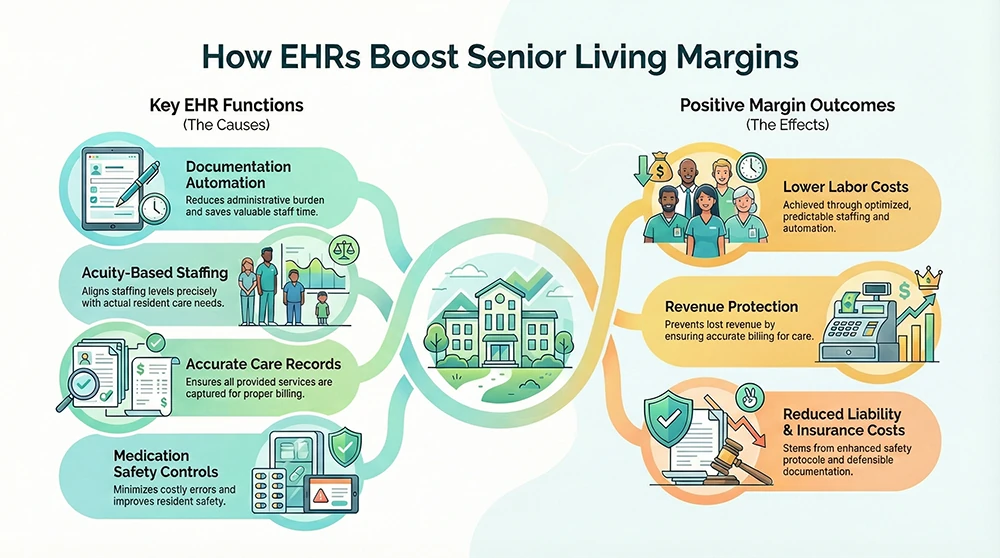
Documentation Automation That Reduces Labor Waste
Caregivers in assisted living and memory care often feel that documentation pulls them away from residents. Paper flows, sticky notes, and duplicate entry into multiple systems all burn time that you still have to pay for (4). Over the course of a year, that extra time becomes overtime, agency usage, and higher turnover.
A senior living focused EHR, such as
Fynn.io’s EHR for Assisted Living & Memory Care, brings care plans, ADL tracking, medication records, incident reports, and shift notes into one consistent workflow. Time and motion studies in healthcare settings show that digital documentation can reduce administrative time by about 20 to 30 percent per caregiver shift (5). For a portfolio of 40 or more communities, that shift adds up to a meaningful reduction in paid but nonproductive time.
When documentation becomes faster and more reliable, you see clearer impact on your margin. You gain better control over overtime, less reliance on agency staff, and more predictable payroll to revenue ratios across your communities.
Smarter Staffing and More Predictable Coverage
You already know that staffing decisions are often made under pressure. A resident’s condition changes, a caregiver calls out, or a family concern rises suddenly. Without good data, teams often staff “just in case,” which feels safer in the moment but raises your labor costs.
Modern senior living EHR systems pull together resident acuity, incident history, and service needs into a clearer view of demand (6). In memory care, this matters even more. Behavior changes, elopement risk, and fall risk can shift quickly, and staffing often follows gut feel instead of a structured view of acuity (7).
When your EHR supports acuity driven staffing, you can:
- Show surveyors and families why staffing levels make sense.
- Reduce overstaffing when acuity is lower.
- Provide better support when risk is higher.
High turnover is another drain on margin. Assisted living turnover often sits above 45 percent per year, and replacing each caregiver can cost between 3,500 and 5,000 dollars in recruiting, training, and lost productivity (8). Clear, data based staffing models can reduce burnout, improve fairness in assignments, and help you hold on to the people you already invested in.
Documentation That Protects Revenue Instead of Letting It Leak
Margins improve not only when you reduce costs, but also when you protect the revenue you have already earned. In senior living, incomplete or inconsistent documentation can create billing disputes, missed charges for additional services, and weaker positions in legal or insurance reviews.
An EHR gives your organization time stamped, traceable records of what care occurred, when it occurred, and who provided it (9). For memory care, where families may question the quality or consistency of care after a fall, elopement, or hospitalization, this record matters a great deal.
When your documentation is complete and easy to retrieve, you can:
- Support private pay rate structures with clear evidence of the services delivered.
- Reduce denials or disputes tied to missing or unclear records.
- Defend your communities more effectively in arbitration or litigation.
Liability cases related to negligence in senior living can cost more than 150,000 dollars in legal defense before settlement costs are considered (10). Strong documentation does not eliminate all risk, but it gives you a stronger position and can reduce both frequency and severity of claims.
Stronger Survey Readiness and Lower Regulatory Risk
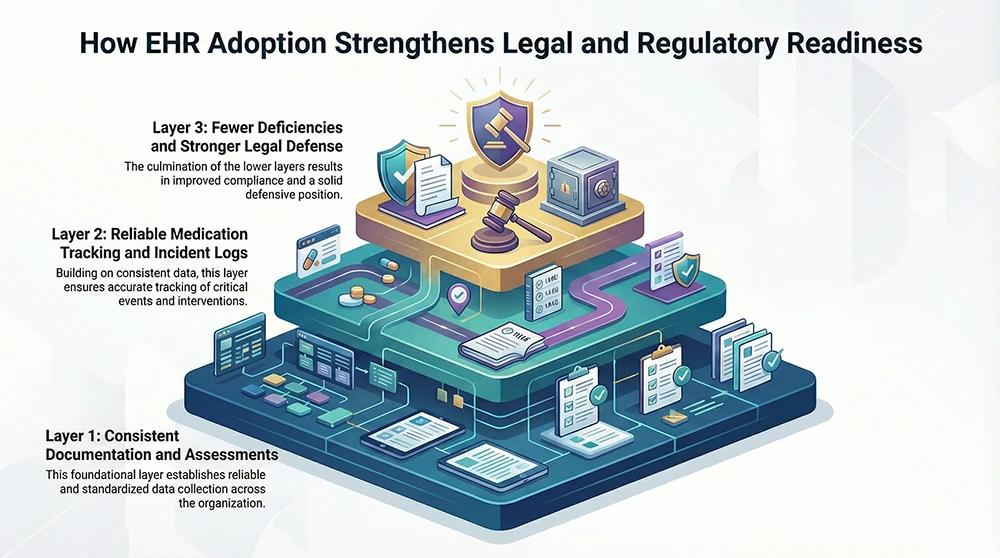
Regulatory issues often start as documentation issues. A service was provided, but it was not documented clearly, or surveyors cannot see the full story of a resident’s care journey. The result can be deficiencies, corrective action plans, fines, or temporary limits on admissions (3).
When your team uses your EHR consistently, survey readiness becomes a daily habit instead of a last minute scramble. Resident assessments, care plans, medication histories, incident reports, and staff training records stay in one place and are easier to present when surveyors arrive (11).
Survey teams and state agencies increasingly expect communities to provide fast access to electronic records, especially for memory care programs with higher risk residents (11). If your EHR can show a clear, chronological story for each resident, you lower the chance that a documentation gap turns into a major deficiency.
Preventing even a single serious enforcement action across your portfolio can protect a large amount of annual revenue and avoid emergency spending on remediation.
Medication Safety That Supports Insurance and Risk Management
Medication management is one of the most sensitive and risky areas in assisted living and memory care. Studies show that more than 20 percent of adverse events in senior living involve medication errors, many of which tie back to manual MAR processes or unclear documentation (12).
EHR systems with electronic medication administration records give your nurses and caregivers tools that reduce common failure points. For example, they can confirm the right resident, medication, dose, and time at the point of care. The system can alert staff to missed or late doses and record each administration and exception in real time (12).
This level of tracking does more than protect residents. It also shows your insurance partners and risk managers that you have structured controls around high risk processes. Over time, better medication safety can support more favorable liability insurance terms, lower claim reserves, and fewer high dollar events tied to preventable errors (13).
Standardization That Makes Growth More Sustainable
As you add communities, it becomes harder to manage operations through personal relationships and one off processes. Each site tends to build its own way of documenting care and communicating issues. That variation creates hidden financial risk, because you cannot easily compare performance or see problems early.
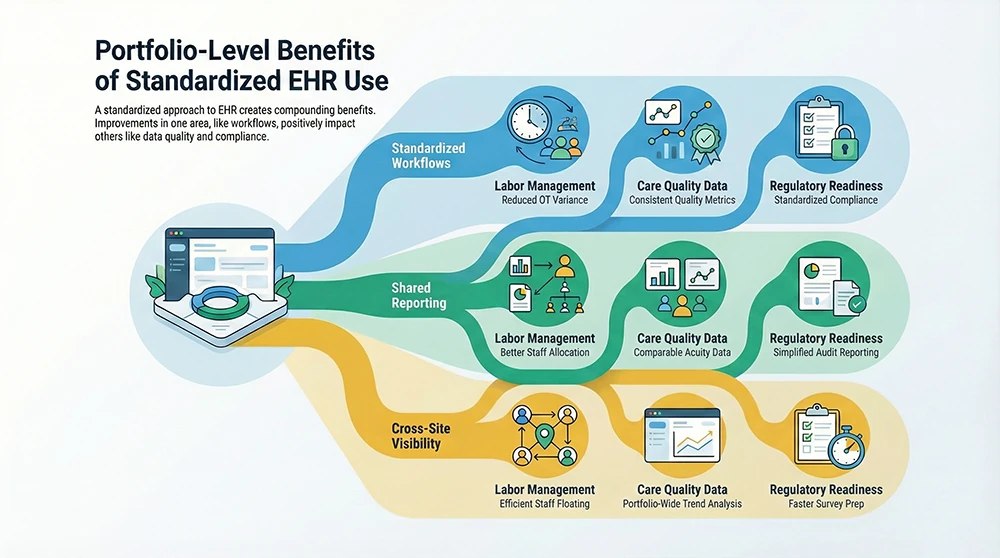
A portfolio wide senior living EHR gives you a common foundation for documentation and reporting, while still allowing state specific or program specific customization where needed (14). When care plans, ADL scores, incidents, and assessments follow the same structure, you can compare communities with more confidence.
This standardization supports your margin in several ways. You can identify outlier labor use, monitor incident trends across regions, and discover which communities maintain documentation compliance without constant reminders. You also give new leaders and clinicians a familiar environment as they move between communities, which reduces training time and performance drift.
Executive Visibility and Data That Support Confident Decisions
At your level, you need more than anecdotal reports. You need clear, timely information that can connect clinical and operational activity to financial results. Many EHR platforms now feed dashboards that bring together occupancy, acuity, staffing, incident rates, and documentation compliance (15).
When your EHR and analytics stack are aligned, tools like
Fynn Pulse
can help you see patterns across your full portfolio. You can track which communities are trending up or down on key metrics, and you can link changes in care or staffing to shifts in NOI.
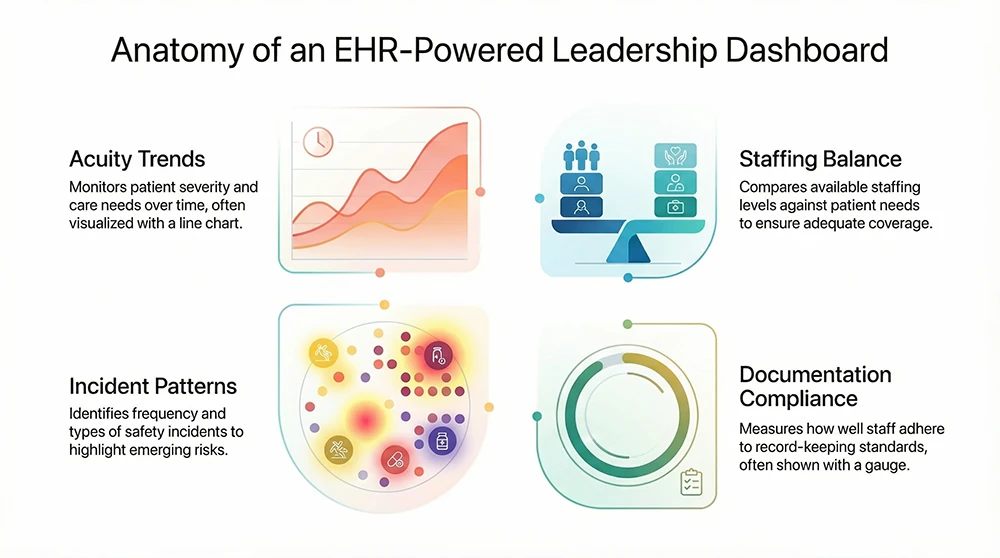
This kind of visibility supports more grounded decisions. You can shift resources to communities that truly need them, intervene earlier when risk is rising, and present clearer operational stories to investors, lenders, and board members.
Faster Onboarding and Lower Training Costs
High turnover means you are constantly hiring and onboarding new team members. Each time someone new joins, you pay for the time it takes them to learn your systems and become fully productive. If each community uses documentation in a different way, this learning curve becomes longer and more frustrating (16).
A cloud based senior living EHR that is consistent across communities makes onboarding simpler. New hires see the same screens, workflows, and expectations wherever they work. In system prompts and standardized workflows guide them through documentation. This can shorten the time required to reach full productivity by several days per new hire (16).
When you multiply that time savings across dozens of communities and hundreds of hires per year, you see real dollars saved, along with better early experiences for new employees.
EHR Maturity, Exit Readiness, and Valuation
If your long term plan includes recapitalization, a sale, or more aggressive growth, buyers will look closely at your technology stack. They want to know if your data is reliable, your compliance risk is managed, and your basic workflows can scale.
Portfolios with consistent EHR use and clean data often receive stronger interest and better multiples, particularly when memory care represents a significant part of the census (17). Investors and lenders view this as a sign that the organization manages risk and understands its own performance.
In other words, EHR maturity can influence not only current margin, but also the value of the enterprise when you decide to transact.
Why Smaller Multi-Community Operators Often See Faster ROI
Large national brands may have more resources, but smaller multi-community operators often feel the impact of an effective EHR more quickly. You tend to run with leaner teams, carry less slack in your budget, and feel labor swings more sharply. When documentation becomes faster, staffing becomes more predictable, and incidents are easier to track and respond to, the improvements show up sooner in your P&L (6)(8).
Because of this, you can think of EHR adoption and optimization as a core part of your margin strategy, not a side project for clinical leaders alone.
The Practical Shift: EHR as a Margin Tool You Actively Use
If you treat your EHR as a central part of how you run the business, it becomes more than a repository of notes. It becomes:
- A way to reduce wasted labor time.
- A source of defensible documentation that protects revenue and reduces legal risk.
- A foundation for consistent operations and growth.
- A shared data layer that helps you and your team make better decisions.
For a CEO leading 40 or more assisted living and memory care communities, these effects are not theoretical. They can be measured, tracked, and strengthened over time.
Conclusion: Building Stronger Margins Through Better Use of EHR
The financial pressure on senior living will not disappear. Labor markets are tight, regulatory oversight is active, and families expect more insight into care. In this reality, your EHR is one of the few tools that touches clinical work, operations, and finance every day.
When you invest in the right senior living EHR and commit to consistent use across your portfolio, you support better margins through labor efficiency, better documentation, lower risk, and executive level visibility (2)(3)(5)(11)(15). For small and mid-sized assisted living and memory care providers, this is one of the most direct and practical ways to build a stronger and more resilient business.
References
- National Investment Center for Seniors Housing & Care (NIC), Operating Cost Trends
- U.S. Bureau of Labor Statistics, Healthcare Labor Expenditure Reports
- Office of Inspector General (OIG), Senior Living Compliance Risk Bulletins
- Agency for Healthcare Research and Quality (AHRQ), Documentation Burden Studies
- Journal of Nursing Administration, EHR Workflow Efficiency Studies
- National Center for Assisted Living (NCAL), Staffing Standards Guidance
- Alzheimer’s Association, Memory Care Staffing and Acuity Reports
- PHI National Workforce Data Center, Long-Term Care Turnover Statistics
- American Health Law Association, EHR Legal Defensibility Guidance
- CNA Insurance, Senior Living Liability Claims Reports
- State Health Department Survey Protocols (Multi-State Review)
- Institute for Safe Medication Practices (ISMP), Long-Term Care Error Reports
- NAIC, Senior Living Insurance Underwriting Risk Assessments
- CMS Interoperability and Data Standardization Guidelines
- HFMA, Healthcare Financial Analytics in Long-Term Care
- LeadingAge Workforce Onboarding Cost Studies
- Irving Levin Associates, Senior Housing Transaction Valuation Reports
Disclaimer:
This article provides general information for educational purposes and does not constitute legal, regulatory, financial, or compliance advice. Assisted living and memory care regulations vary widely by state and may change without notice. Requirements related to HIPAA, cybersecurity, documentation, and electronic health records depend on your organization’s structure, payer relationships, billing methods, and operational practices.
You should consult qualified legal counsel, regulatory specialists, or state licensing authorities to determine the specific obligations that apply to your communities and to verify how the guidance in this article relates to your organization’s compliance responsibilities.
.jpeg)
.jpeg)